

P1 / INITIALIZE
Behavior cloning
Behavior-clone successful teacher demonstrations to give the student its initial web skills.
The student’s task
Find the price of the most expensive bookshelf.
fill('15', 'bookshelf')fill('31', 'bookshelf')Teaching Agents in Their Own Style:
Black-Box Teacher Distillation for Web Agents
01 Overview
WEBKD trains web agents using text-only corrections from a black-box teacher. The teacher identifies the first error in a student trajectory and edits the remaining responses at their original contexts.
Corrections preserve the student’s reasoning style while changing incorrect decisions.
I need to search for “bookshelf”. The search box is 31, so I’ll type there.
1. Type bookshelf → 2. Search → 3. Compare prices.
fill('31', 'bookshelf')The action is corrected, while the short, direct phrasing stays close to the student’s style.
Adapted from Figure 1; text simplified for illustration.
02 The method
Fixed-context editing, action-informative weights, and the role-asymmetric training objective.
View the static diagram ↗Behavior-clone successful teacher demonstrations to give the student its initial web skills.
Collect its own trajectories. Failed attempts become edit targets; successes provide examples of its style.
The teacher identifies the earliest error that sends the task off course. Earlier correct steps stay intact.
Correct each response in the faulty suffix at the student’s original context, using its writing as a guide.
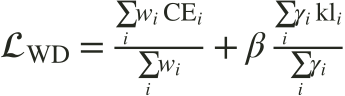
Each term is normalized by its own weight sum; β controls the anchor strength.

This is a difference in log perplexities, not raw perplexities. Uniform training can spend its largest loss on unfamiliar wording instead of the useful decision.

Both scores use the frozen behavior-cloned student. A span earns credit when its presence increases the probability of the corrected action. Negative contributions stay in the ranking.

Ranks are normalized within each step; ties share their average rank. With φ = 0.1 and τ = 0.05 nats, identical contributions yield 0.55. Action and step CE weights are pinned to 1.

Here pᵢ is the current student’s target-token probability and qᵢ is the frozen seed’s. On corpus target tokens, use γ = 1 for think/plan/memory and γ = 10⁻⁶ elsewhere. This pointwise surrogate is not an exact full-vocabulary KL. β = 0.03 in the reported configuration.
Notation: πBC is the frozen behavior-cloned seed, πθ is the student being trained. Explore the formulas and a numerical example ↗ · Appendix B.4–B.5 ↗
03 Evaluation
TimeWarp and OnlineMind2Web evaluation. Select a student model to compare methods.
Evaluation on the interface version seen during training.
See Table 1 in the linked preprint for the reported values.
Success rate (%)
Mean ± standard error over three runs. Selected baselines; the complete table is available below.
Evaluation across five interface versions held out from training.
See Table 1 in the linked preprint for the reported values.
Success rate (%)
Mean ± standard error over three runs. The table reports all five unseen versions for the selected student.
Live-web evaluation of Qwen 3.5 4B and Qwen 3.5 9B.
Success rates are provided in the supplied results table.
Success rate (%)
Success rate (%) ± standard error over three runs. Difficulty views report success within each subset: 61 easy, 106 medium, and 61 hard tasks (228 total).
04 Paper and citation
Kahlert School of Computing, University of Utah
Read on arXiv@misc{ishmam2026webkd,
title={Teaching Agents in their Own Style:
Blackbox Teacher Distillation for Web Agents},
author={Ishmam, Md Farhan and Marino, Kenneth},
year={2026},
eprint={2610.19834},
archivePrefix={arXiv},
primaryClass={cs.AI},
url={https://arxiv.org/abs/2610.19834}
}